

Click on the book for word by word meaning from IITK website

Click on the bow to listen to the audio by SrIrAma ghanApATi
Hari Om.
Let us begin the first sarga of the ayOdhyakAnDam with offering our prostrations at the lotus feet of SrIrAma and our sathguru.
Welcome to the ayOdhya kAnDam – the canto of dharma. This canto essentially deals with why rAma is celebrated as the very embodiment of dharma for eternity. This is a large canto comprising of 119 sargas or chapters which begins with the preparations for the coronation of rAma as the heir apparent future king of ayOdhya but finds a twist in which he is forced to go to forest for fourteen years leaving the kingdom for his brother bharata. lakshmaNa and sIta insist on accompanying him and he yields. bharata returns from his maternal grandfather’s place upon receiving urgent summons from the preceptor to an utterly miserable ayOdhya where the king daSaratha is dead and his dear brother rAma is in exile – all because of his mother who was in the spell of a wily witch called manthara! bharata who could have ruled ayOdhya without being blamed for it, chooses to go to the forest to persuade rAma to return and rule over ayOdhya. A resolute rAma refuses to yield. Finally bharata returns with the holy sandals of rAma and installs those on the throne of ayOdhya. He rules ayOdhya as a proxy for rAma for the fourteen years.
The canto beautifully highlights the love of everyone for rAma in their own highly expressible way. mahaRshi vAlmIki serves a veritable feast of love, affection, poignance and tragedy as we navigate through these terrains. Why delay then. Let’s jump headlong and I pray for inspiration! Onwards…
Prince bharata along with the tormentor of enemies, the blemishless Satrughna left for the abode of his maternal uncle (in the kingdom of kEkaya). They were very well taken care of in the maternal place with their uncle looking after them like his own sons. Even though they were pretty satisfied with their stay there, the two valorous brothers constantly remembered their aged father daSaratha. Even the king daSaratha in ayOdhya very often remembered the two brother bharata and Satrughna who were verily like the gods indra and varuNa. The king loved all the four brothers, best among men, equally as though they were four hands projected out of his body. Even among the four, the resplendent and virtuous rAma caused great delight to his father, just like lord brahma delighted the beings.
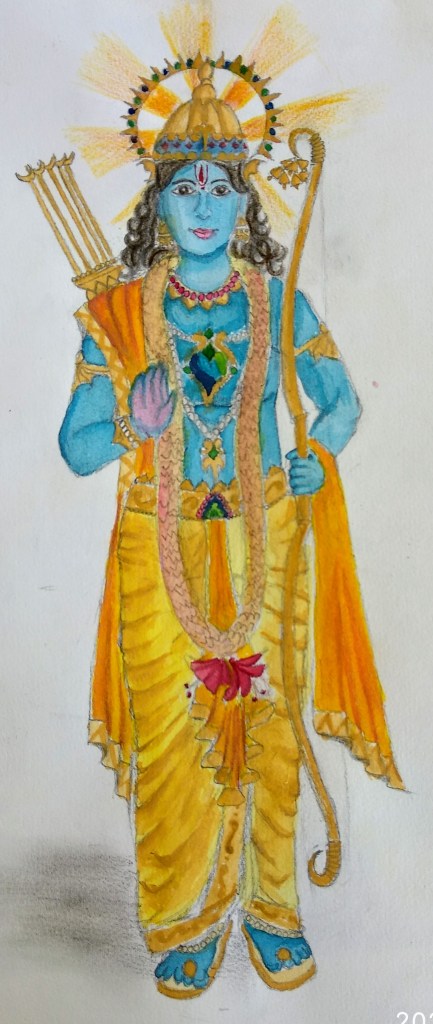
rAma was in reality, the eternal vishNu, born in this world due to the prayers of the gods who were desirous of the vanquishing the puffed up demon rAvaNa. Mother kausalya shone brilliantly in the company of her son rAma just aditi shone in the company of her son, the lord of gods, wilder of the thunderbolt – indra.
rAma, the peerless son of daSaratha was handsome, heroic, bereft of envy and was as virtuous as his father. rAma always had a calm and serene mind, was of soft speech so much so that he never retorted to harsh speech in a harsh manner.
rAma was so self assured that even if someone did a small favor to him, he would remember it forever but even if someone did a hundred disfavors, he would not care to remember.
कथञ्चिदुपकारेण कृतेनैकेन तुष्यति।
न स्मरत्यपकाराणां शतमप्यात्मवत्तया।।2.1.11।।
In the small breaks that he got during the practice of weapons, he lost no opportunity to interact with elderly gentlemen and those rich in conduct and wisdom. Endowed with a sharp intellect, he practiced sweet speech and greeted people with pleasing words before they could greet him. Even though he was valiant, he never really was in awe of his might. He never spoke untruth, was scholarly and was ever eager to serve elderly scholars. The love and affection between him and his subjects was mutual.
He was compassionate towards the forlorn, conquered anger, righteous, self restrained, was pure in his conscience and revered learned brAhmins. His elevated thoughts were befitting the exalted race of the ikshvAkus. He reveled in his duties of a kshatriya and gave it high consideration. He also believed that one could achieve the high heavens by excelling in the appointed duty. He never entertained speech that was against someone or that was not beneficial. In debates his rhetoric was equal that of the learned bRhaspati. rAma was young, eloquent, endowed with a well toned healthy body and had an excellent sense of time and context. He was adept in judging the ability of others and was sagely in his conduct in the world.
Laced with such endearing qualities, rAma was verily the life breath of his subjects. rAma mastered all aspects of learning including vEda and its associated branches and exceled even his father in archery. Born into the noble race, he was never mean, ever truthful and upright. Trained under learned elderly brAhmins in matters of dharma and artha (righteous conduct and finance), he was adept at these. He had an elephantine memory and was a genius with expertise in social conduct appropriate to the time and occasion and also the tradition.
rAma was modest, never wore his feelings on his sleeve and could keep secrets. Neither his anger nor pleasure went ever in vain (he knew when to show what!) and neither did his sacrifice or restraint. Steadfast in his devotion and wisdom, he brooked no falsehood neither spoke unthoughtful words. Never careless or lazy, he had an accurate judgement of his faults as well as those of others.
The learned and grateful person that rAma was, he was also adept in identifying the relative merits of people. With his discriminatory power, he dispensed justice either by favoring or restraining as was appropriate. He knew the means of income and to administer expenditure accordingly. He sought pleasure only after ascertaining the source and righteous nature of it and never lazed. He had a keen understanding of the art and craft that was meant for the entertainment of the populace.
He was the best in the use of weaponry, had a mastery of all associated subjects, was the best known archer and celebrated as an atiratha (an unrivalled warrior) acknowledged by those skilled in the art and peers. Expert in commanding troops, mounting of horses and chariots, he was irrepressible in advancing towards the enemies and could not be restrained either by the demons or gods. Even so, he had no trace of malice or jealousy, conquered anger and was not proud. He never slighted any being. In forbearance he was like the earth, in intellect he shone like bRhaspati, in valour he was reminiscent of indra. Being the embodiment of such lofty virtues, the populace loved him, he caused much delight to his father by this. He shone forth like the guardian deity of the worlds and the earth herself desired him as her ruler!
Beholding such a son with virtues unparallel, king daSaratha remembered his advanced age and while alive fondly fancied coronating rAma as the king. The very thought of seeing rAma as the king filled his heart with bliss! He thought, rAma was more welcome like the rain bearing clouds to the populace than even himself by virtue of his desire to bring prosperity to the folks.
daSaratha also realized rAma as being the epitome of valour, intellect, wisdom and firmness even excelling his father. Seeing the confluence of every single virtue that was needed in a king and yet rarely found in all kings, daSaratha consulted ministers about coronation of rAma as the prince regent. The fact that the king himself was of advanced age and the ominous portents on the earth and the sky for his own life made the king decide firmly to coronate rAma as the future ruler of ayOdhya. He was convinced that this was the only way to secure the future of his subjects as well as his own and then called for a meeting of the important citizens and tributary kings of his kingdom to discuss the proposal of the coronation of rAma as the prince regent.

As the important people arrived, the king received them with due hospitality and made arrangements for their comfortable stay and presented them with ornaments. Surrounded by them, he looked verily like the lord brahma in the assembly surrounded by the gods. King janaka and king of kEkaya could not be invited due to the short notice in which the meeting was held and daSaratha opined that the glad tidings of rAma’s coronation would be intimated to them shortly. As he took his seat in the assembly, other important citizens and tributary kings made it in to the assembly and assumed the appropriate seats duly allotted to them. The assembly was reminiscent of that of the gods presided over by lord indra.
Here we conclude the first sarga of the ayOdhya kAnDam of SrImath vAlmiKi rAmAyaNam and humbly offer it at the lotus feet of SrIrAma. Hari: Om!
jAi SrIrAma.
Next: 2.2. rAma reigns in the hearts of people!
Previous: 1.77. rAma, the darling of all
 rAmabhaktisAmrAjyam