
Hari Om.
Let us begin the one hundred and twenty eighth sarga of the yuddha kAnDam by offering our prostrations at the lotus feet of SrIrAma and our sathguru.
As hanumAn landed in nandigrAma in a human form, he saw the pAdukas of rAma enthroned and bharata wearing bark and matted hair was ruling as the representative of rAma. He shone resplendently like a brahmaRshi. As the vAnara warrior paid his respects and narrated the life of rAma during the exile and his achievements, bharata turned ecstatic. He couldn’t wait to meet and fall at the feet of rAma and hand him back the kingdom whose burden he had carried successfully for fourteen years. The city of ayOdhyA transformed into a zone of celebrations overnight. Their beloved rAma would come the following day. Citizens were up early and rushed towards nandigrAma to catch the first glimpse. bharata was anxious. He prostrated to the vimAna that carried rAma when he sighted it. The man they pined for, the man they ran behind to the forests, the man who left them in deep sleep and went off in the wee hours near the river tamasA was back today. Prince bharata lost no time in submitting the kingdom at his feet and said…. Onwards…
Offering his loving respects with hands folded and held above his head, bharata, the enhancer of the delight of kaikEyI, addressed the elder brother rAma and said –
“You had honored my mother by giving me this kingdom. I am submitting it back to you just how you had given it to me. This heavy burden (of the kingdom) is to be pulled by a powerful bull. I am like a calf who cannot pull it. Just like the raging floods wash away a bridge, it is hard for me to keep a kingdom intact with all its attendant challenges. O rAma, just like a donkey cannot mimic the speed of a horse nor can a crow match the gait of a swan, I cannot do what you are good at doing. A tree that has been planted in the courtyard, which grows big with its branches, blooms but the flowers fall off without bearing fruits, then the whole point of growing that tree becomes pointless. Even so, O mighty armed, father daSaratha tended you and shaped you to rule over ayOdhyA and if you don’t do it despite being so able and surrounded with mighty friends, it would be inappropriate. This example fits you well. Therefore, O lord of men, please rule over your devout subjects and followers. Let the entire world witness the glory of your crowning that would be resplendent like the sun at the noon. O rAghava, you should wake up in the morning to jingles of the anklets and to sweet music (indicating that you should be the king). As long as the wheel of time and the earth spin, until then you assume the lordship of everyone.”
यावदावर्तते चक्रम् यावती च वसुन्धरा ।
तावत्त्वमिह लोकस्य स्वामित्वमभिवर्तय ॥
भरतस्य वचः श्रुत्वा रामः परपुरञ्जयः ।
तथेति प्रतिजग्राह निषसादासने शुभे ॥
Honouring the words of bharata, rAma said “so be it” and assumed charge and took his seat. Satrughna then arranged for expert hairdressers. First bharata took the ablutions followed lakshmaNa, sugrIva and vibhIshaNa. At the end, rAma untied his matted hair and dressing it up, took the ceremonial bath. Fragrant unguents were applied on him and then dressed in impressive clothes, rAma shone in splndour. Both the scions of the ikshvAku kingdom, rAma and lakshaNa wore sparkling and appropriate jewels. sugrIva and hanumAn also took their ablutions and got ready bedecked in impressive jewels.
While the experts did this to rAma, kausalyA and other womenfolk of daSaratha readied sItA themselves. They also did that to the consorts of the vAnara warriors as a mark of gratitude for the help they have rendered to their son. The well decked wives of sugrIva along with sItA were eager to witness the city.
There in ayOdhyA, the ministers aSoka, Vijaya, sumantra and others conferred with the preceptors and made arrangements for the prosperity of the city and the citizens and to perform the crowning of the great king who deserved victory in an auspicious manner. Having instructed the preceptors to ensure all the arrangements, the ministers left for nandigrAma, eager to behold rAma.
Instructed by Satrughna, the minister sumantra summoned a glorious chariot that was superbly decorated and glowed like the solar orb. The truly valorous rAma graced the splendid chariot to go to the grand city of ayOdhyA. bharata took the reins of the chariot and Satrughna held the parasol over rAma’s head. lakshmaNa fanned rAma with fly-whisk and so did vibhIshaNa with another.
जग्राह भरतो रश्मीन् शत्रुघ्नश्छत्रमाददे ।
लक्ष्मणो व्यजनन् तस्य मूर्ध्नि सम्पर्यवीजयत् ॥
Scores of Rshis, gods and maruts witnessed the procession from the skies and heard the music and the eulogies addressed to rAma. The best among the vAnaras, sugrIva mounted on the giant elephant by name Satrunjaya. Nine thousand elephants followed him with a vAnara in very well dressed and bejewelled human form mounted on each one of them. Accompanied by blowing of conches and trumpets, the best among men, rAma headed for that city full of sky scrapers.
The citizens beheld their beloved rAghava seated in the chariot reflecting his great valour. They hailed rAma, extending their wishes and blessings and followed his chariot. Accompanied by the ministers, preceptors and citizens, rAma shone forth like the moon in the middle of stars. People carrying auspicious symbols and playing cymbals headed in front of the chariot boisterously showering sacred rice and gold pieces. Cows, maidens and brAhmins led the procession of overjoyed subjects whom the chariot followed.
सख्यं च रामः सुग्रीवे प्रभावं चानिलात्मजे ।
वानराणां च तत्कर्म ह्याचचक्षेऽथ मन्त्रिणाम् ॥
श्रुत्वा च विस्मयं जग्मुः अयोध्यापुरवासिनः ।
वानराणां च तत्कर्म राक्षसानां च तद्बलम् ॥
As they went, the ministers announced to the citizens, the friendship of rAma and sugrIva, the might of hanumAn, the enterprise of the vAnaras, the might of the demons and the manner in which vibhIshaNa sought the refuge of rAma. The citizens were astonished to know these details. Surrounded by vAnaras, the resplendent rAma entered the city of ayOdhyA which was teeming with joyous and well-to-do citizens. Flags were fluttering on top of all the houses and slowly the chariot reached the abode of the king daSaratha. Entering the residence of his father, rAma prostrated to his mothers and then in a gentle voice told bharata –
“O brother, please take sugrIva to my exquisite abode which is laden with gems and jewels and arrange for his stay there”.
bharata took sugrIva by hand and entered the mansion of rAma. Instructed by Satrughna, immediately attendants came with arrangements of lights and beds to the mansion. The resplendent brother of rAma (bharata) then requested sugrIva to instruct his vAnaras to fetch waters for the crowning ceremony (paTTAbhishEka). At once, sugrIva gave a golden pot to four vAnaras and ordered them that by dawn they must have potful of waters from each of the ocean on the four directions. The elephantine vAnaras at once took to the skies carrying the golden pots and leapt with the speed of garuDa. Among them jAmbavaN, hanumAn, vEgadarSi and Rshabha brought waters in pots from five hundred rivers! sushENa fetched waters from the eastern sea, Rshabha from the southern sea, gavaya from the western ocean and the pious nala brought waters from the northern sea respectively. Satrughna arranged all the pots of the waters so brought and requested the preceptors to start the proceedings of the paTTAbhishEka.
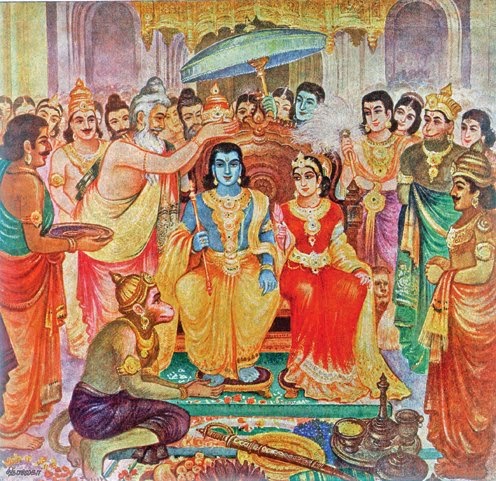
Then the elderly vasisTha along with other preceptors made rAma sit on a golden pedestal along with sItA. The eight preceptors vasisTha, vAmadEva, jAbAli, kASyapa, kAtyAyana, suyajna, gautama and vijaya gave the ceremonial bath with fragrant waters just like the vasus had anointed indra in the yore. Turn by turn, Rtwiks, brAhmins, maidens, ministers and soldiers gave the ceremonial bath with all the medicinal and fragrant herbs to rAma in great delight. The celestials, gods and the guardian deities witnessed this grand spectacle from the skies.
वसिष्ठो वामदेवश्च जाबालिरथ काश्यपः ।
कात्यायनः सुयज्ञश्च गौतमो विजयस्तथा ।
अभ्यषिञ्चन्नरव्याघ्रं प्रसन्नेन सुगन्धिना ।
सलिलेन सहस्राक्षम् वसवो वासवं यथा ॥
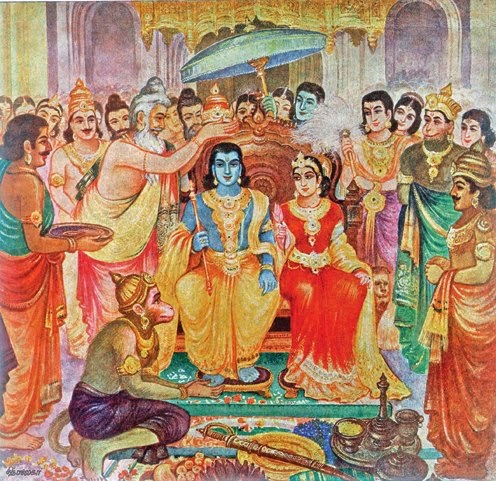
Then vasisTha brought the crown which was made by lord brahma himself and with which manu was crowned first. The lovely crown studded with gems had been passing through the generations and being held by every crowned king of the ikshvAku dynasty. Post the ceremonial bath, the Rtwiks decked rAma with a variety of ornaments. The preceptor vasisTha then crowned rAghava with the traditional crown of the ikshvAku dynasty. Satrughna held the parasol, sugrIva fanned with the fly-whisk and so did vibhIshaNa with another.
Prompted by indra, vAyu, the wind god presented a garland of hundred lotuses studded with precious gems and stones to rAghava. The gods and the gandhrvas sang, the apsaras danced in delight as that very eligible rAma assumed charge as the king after his paTTAbhishEka. As the celebration of rAghava’s paTTAbhishEka went on, the earth was prosperous with good yield of crop, the trees bore fruits and the fragrance of flowers permeated everywhere. A hundred thousand cows, horses, a hundred bulls and thirty crore gold coins along with impressive clothes and ornaments were given in charity by rAghava to the brAhmins.
The son of vAlI, angada was gifted two golden armlets (angadas) studded with diamonds and gems. rAma gifted a glorious necklace with gems and pearls to sItA. She then presented clothes and ornaments to the son of the wind god, hanumAn. She then took out a necklace and started looking at the vAnaras and her husband in turns.
Grasping what was going on in her mind, rAghava said to the daughter of janaka –
“O gracious one, you can gift this necklace to the one you are most pleased with”.
Then the lotus-eyed lady offered the necklace to the son of the wind god in whim manliness, valour and intellect are always abound. Wearing that necklace hanumAn looked glorious like the white mountain sparkled under the light of the moon. Then the king, rAma showered clothes and ornaments on dvivida, mainda, nIla and other vAnaras. He then felicitated sugrIva, vibhIshaNa and hanumAn in an appropriate manner with ample amounts of gems.
Having witnessed the paTTAbhishEka of rAma and received his felicitations, sugrIva along with other vAnaras headed to kishkindhA happily after bowing down to rAma. The king of lanka, vibhIshaNa received a replica of the lord of the iksvAkus (SrIranga nAtha) and headed to lanka in great delight.
The illustrious rAghava, knower of dharma said to lakshmaNa who observed dharma –
“O knower of dharma, come and get anointed as the crown prince to rule over the earth secured by our forefathers with equal authority as me.”
Despite being requested repeatedly, saumitri didn’t agree to become the crown prince and then the great rAma anointed bharata as the crown prince.
The king rAma performed many paunDarIka, aSwamEdha, vAjapEya and a number of other yajnas. In the ten thousand years that he ruled, rAghava performed a hundred aSwamEdha yajnas and with lakshmaNa as his confidante ruled over the earth as per dharma.
When rAma ruled, there existed no widows and there was no fear from snakes or diseases. The world became bereft of dacoits and no one was touched by calamity. Elders never performed obsequies of their youngsters. There was joy everywhere and dharma was all over. The subjects never harmed each other being absorbed in rAma.
सर्वं मुदितमेवासीत् सर्वो धर्मपरोअभवत् ।
राममेवानुपश्यन्तो नाभ्यहिन्सन्परस्परम् ॥
When rAma ruled, the subjects lived for thousands of years and bore thousands of children and were free of disease and dejection. The stories of rAma were retold in every home and the entire world was filled with him as he ruled.
सर्वं मुदितमेवासीत् सर्वो धर्मपरोअभवत् ।
राममेवानुपश्यन्तो नाभ्यहिन्सन्परस्परम् ॥
The tress were healthy spreading their branches and bore flowers and fruits all the time. The clouds rained in time and wind touched everyone gently. The four orders of subjects – brAhmins, kshatriyas, vaiSyas and SUdras lived happily busy with their own wares without avarice. All were virtuous and dhArmic, busy in dhArmic activities and there were no fraudsters in rAma’s kingdom. The illustrious rAma, along with his brothers ruled for eleven thousand years thus.
This first epic poem, written by vAlmIki in the yore brings about dharma, fame, longevity and victory to the kings to whoever recites it and relives them of all sins.
धर्म्यं यशस्यमायुष्यं राज्ञां च विजायावहम् ।
आदिकाव्यमिदं चार्षं पुरा वाल्मीकिना कृतम् ।
पठेद्यः शृणुयाल्लोके नरः पापात्प्रमुच्यते ॥
By listening to the episode of the paTTAbhishEka of rAma, the desires regarding progeny and prosperity are obtained by men in this world and the kings will win over their enemies and establish themselves.
Women who listen to this will be blessed with children like rAma, lakshmaNa, bharata and Satrughna and will be happy like their mothers. Those who listen to this epic rAmAyaNa written by mahaRshi vAlmIki with Sradhha and holding his senses in check will be blessed with long life, and overcome trials and tribulations in life. They will reunite with their loved ones at the end of the exiles and will get all they pray for from rAghava himself.
By listening to the epic rAmAyaNa, all the gods are pleased and the obstructions at home are removed. The kings secure victory and the traveller will secure good. Women who listen to this epic will give rise to good children. By worshipping this epic and listening to this itihAsa of the yore, all will be relieved of sins and secure long life.
If kshatriyas bow down to brAhmins and listen to this with epic regularly from them, there is no doubt they will secure prosperity and progeny. By the regular recitation and listening to this epic, rAmAyaNa, the eternal vishNU in the form of rAma will be pleased. The mighty armed, first god vishNU is verily rAma and his AdisEsha is lakshmaNa.
Let the narration of this epic of the yore bring you all good. Let the bad perish and let the might of vishNU rise. By listening to the poem rAmAyaNa, the gods are delighted and so are the pitR dEvatas. Those who devoutly write this rAmAyaNa written by the Rshi as it is, they are assured of the heavens.
By listening to this epic, there will be prosperity and auspiciousness in the family, women will secure great food, people will realize everything they would need on this earth. Those desirous of glory and prosperity should listen to this recitation of this from the pious.
JAI SRI RAM
Here we conclude the one hundred and twenty eighth sarga of the yuddha kAnDam of SrImath vAlmiKi rAmAyaNam and humbly offer it at the lotus feet of SrIrAma. Hari: Om!
jAi SrIrAma.
Click on the above link for word by word meaning from IITK website
Click on the above link to listen to the audio by SrIrAma ghanApATi
Next: 1.1 The rAmAyaNam in brief
Previous: 6.127. The grand reunion
 rAmabhaktisAmrAjyam