
Hari Om.
Let us begin the one hundred and fourth sarga of the yuddha kAnDam by offering our prostrations at the lotus feet of SrIrAma and our sathguru.
The battle between rAma and rAvaNa was well tuned into by the celestial folks who hastened to witness the grandest of duels. In the bAla kAnDam, mahaRshi vAlmIki narrates the ordeal of the gods who were being tortured by a very powerful and conceited rAvaNa who had utter contempt for the lives of Rshis and good men and ruled with an iron hand, usurping power, kingdoms, women and most importantly trying to alter the course of nature. The gods went to the grandsire and complained about the immunity that the boons of the lord brahma made rAvAna invincible. The grandsire prophesied that the demon shall meet his end in the hands of a human and invoked lord vishNu and prayed to him. The lord vishNu promised to come as rAma and vanquish rAvaNa and thereafter rule over the earth for 11000 years! So, the first part of the lord vishNu’s assurance was playing out now. The gods felt they need to be ensuring rAma has a level playing field against the mighty demon and lord indra pressed his glorious chariot and the trusted charioteer into action. rAma now fought from the chariot, although on the backfoot initially, rAma soon stepped up and soundly thrashed rAvaNa. It was so bad for him that he was psychologically dented and was unable to retaliate. At this point, trying to save him for another time, rAvaNa’s charioteer deftly deflected the chariot from the war path and took it aside dodging the attack of rAma. Onwards…
rAvaNa’s chariot that was under an overwhelmingly relentless attack from rAma and bent on protecting his master, the charioteer deflected the chariot deftly from the thick of the battle without his instruction. The demon king, out of his poor judgment and drawn by death was livid at his charioteer for this seeming impertinence and showing his angry red eyes, he said –
“You idiot, you have insulted me by acting on your own and showing me as an impotent, powerless, bereft of valour, an unsubstantial coward, inglorious and as if I have been deserted by my magical abilities and astras! Why did you deflect the chariot from the enemy without knowing my opinion and mortify me thus? You ignoble fellow, you have destroyed the fame, heroism, glory and trust in you that I have accumulated over a long time. You have turned me into a coward in front of an enemy who is celebrated for his prowess and heroism. You wicked one, if you do not turn the chariot back to battlefield, I shall surmise that you have been favoured by the enemy. What you have done now is done by the enemies and not by well wishers and friends.
शत्रोः प्रख्यातवीर्यस्य रञ्जनीयस्य विक्रमैः ।
पश्यतो युद्धलुब्धोऽहम् कृतः कापुरुषस्त्वया ॥
Come on, take the chariot back to the battlefield before the enemy leaves if you know me and remember what I like to do”.
As rAvaNa lambasted his charioteer foolishly, the well-wisher articulated in a justifiable manner and said –
“I am neither afraid, nor am an idiot not am I under the siege of the enemy. I am neither out of my senses, nor unfriendly to you and have not forgotten right action. Being your well-wisher I tried to safeguard your fame. Filled with affection for you, I did good although it looks like an evil design. Therefore, O king, on account of this, you who always do good to me, shouldn’t find fault and question my nobility. Listen and I shall tell you why I retreated this chariot from the battlefield when we seemed to be swimming against the current in a gushing river.
I fully grasp that you are tired by the great battle you are waging. I noticed that you were not being assertive or sieging the enemy by your attack. Then I saw these horses which were tired by the heat of the battlefield and the constant onslaught like the cattle feels in the face of a constant downpour.
I see the omens that arising in the battlefield and I reckon those are not good for us.
देशकालौ च विज्ञेयौ लक्षणानीङ्गीतानि च ।
दैन्यं खेदश्च हर्षश्च रथिनश्च महाबल ।
स्थलनिम्नानि भूमेश्च समानि विषमाणि च ।
युद्धकालश्च विज्ञेयः परस्यान्तरदर्शनम् ।
उपयानापयाने च स्थानं प्रत्यपसर्पणम् ।
सर्वमेतद्रथस्थेन ज्ञेयं रथकुटुम्बिना ॥
O mighty one, the navigator of the chariot must be very discerning. He should know the appropriateness of the place and time of the battle. He should be able to grasp the mannerisms, signs, helplessness, hurt and joy of the rathI (the fighter). Further, the charioteer should know whether the ground is level or low, the time of the battle, when to take the chariot towards the enemy and when to withdraw it and how the enemy is fighting.
With a view that you and the horses get a breather and recoup, I withdrew the chariot. Please discard this unhappiness and anger. O warrior, I didn’t act freely in deflecting the chariot but was moved by my affection to the master in doing so. Please order what should be done now and O repressor of the foes and that shall be done in order to relieve myself from the debt of gratitude that I owe you”.
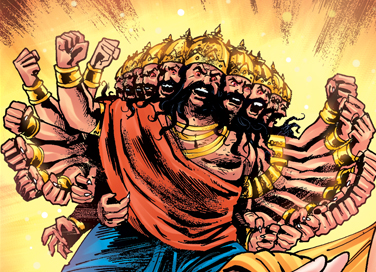
Pacified by the words of the charioteer, the king who was keen for a battle praised him and ordered – “ O charioteer, quickly take this chariot in front of rAghava. This rAvaNa never retreats without vanquishing the foe”.
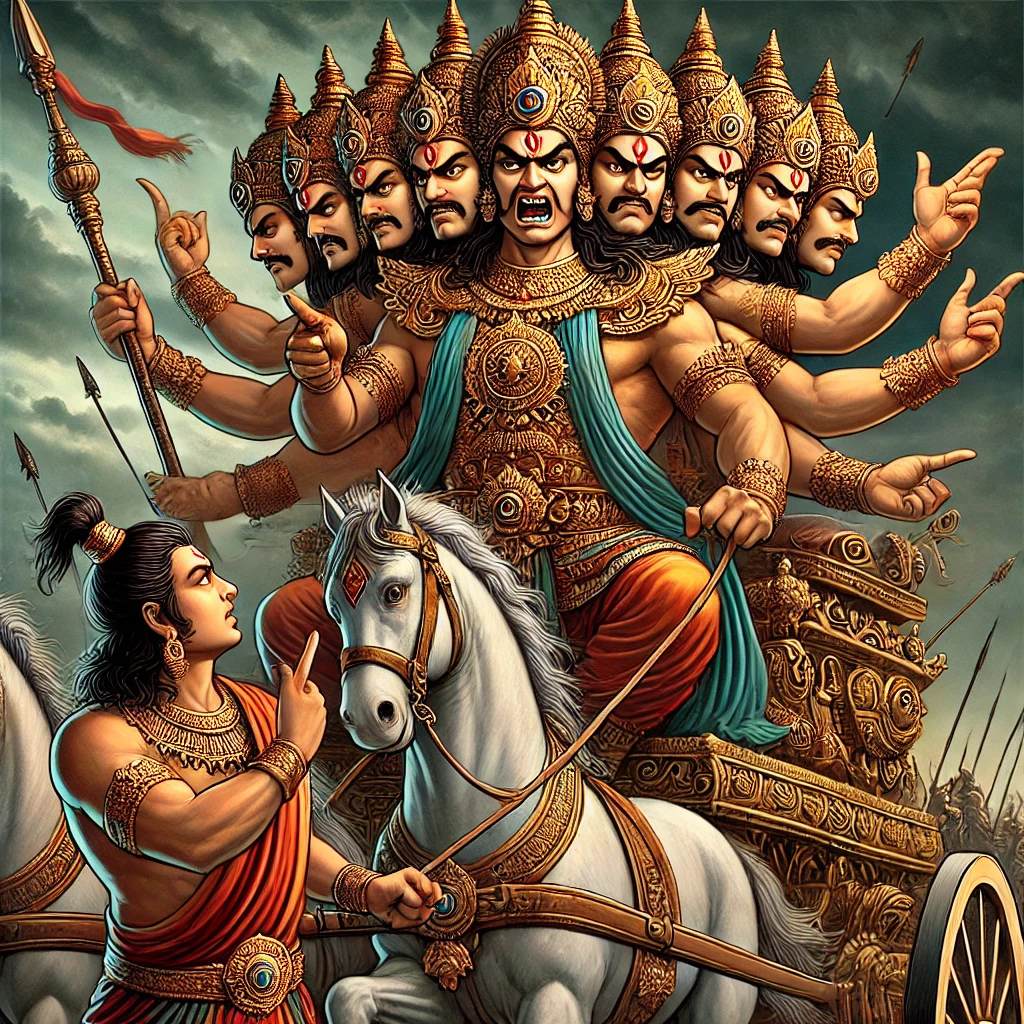
Ordering him thus, rAvaNa removed one of his ornaments from his hand and gave it away to the charioteer. Obeying the orders, the charioteer turned the chariot back towards the battlefield and prodding his horses, navigated the chariot swiftly towards rAghava.
Here we conclude the one hundred and fourth sarga of the yuddha kAnDam of SrImath vAlmiKi rAmAyaNam and humbly offer it at the lotus feet of SrIrAma. Hari: Om!
jAi SrIrAma.
Click on the above link for word by word meaning from IITK website
Click on the above link to listen to the audio by SrIrAma ghanApATi
Next: 6.105. Aditya hRdayam – the conquest conferring hymn to the Sun
Previous: 6.103. Charioteer saves his fear-stricken master
 rAmabhaktisAmrAjyam