
bAla kAnDam, sarga 4
sarga 4, bAla kAnDam
Individual verses with meanings
Listen to the audio of recitation of this sarga
Hari: Om.
Let us begin the fourth sarga by offering our prostrations at the lotus feet of SrIrAma and our sathguru.
In this sarga, maharshi vAlmIki describes the layout of his epic poem, his first disciples who rendered it and how SrIrAma Himself noticed it and heard it, thus validating this account of maharshi vAlmIki. This is a very important sarga given the contents and probably what makes the epic evidential for future writers of rAmAyaNam to emulate and refer to. Let’s get into this without much ado.
The divine sage vAlmIki composed the entire life of SrIrAma and how he regained his kingdom in wonderfully elegant lines. In the epic, maharshi has given 24,000 verses or SlOkams which are contained in five hundred cantos or chapters, called sargas, that are spread across seven kAnDams. He actually mentions it as six kAnDams and the latter one (uttara kAnDa).
चतुर्विंशत्सहस्राणि श्लोकानामुक्तवानृषि:।
तथा सर्गशतान्पञ्च षट्काण्डानि तथोत्तरम् ।।1.4.2।।
The reason for dividing the seven kAnDams as six + one could be that while the six kAnDams describe the birth and youth, exile of rAma from ayOdhya, dwelling in the forests, alliance with the monkey army, searching of sItA and the epic battle respectively and at the time of writing were past events, the seventh kAnDa, named as uttara kAnDa, did not refer to any particular happening and actually comprised of future events. It can be argued that this is the reason maharshi uses the description of six + one to allude to the seven kAnDams or parts that make up his epic. This is, arguably, also the reason why a complete rAmAyaNa recital usually ends at the sixth one with the coronation of lord SrIrAma as the emperor of ayOdhya.
Having composed future events also in the uttara kAnDam, the sage started to wonder about who could perform this epic poem. As mentioned earlier the lines have equal numbers of syllables and can be tuned to a stringed instrument. While he was wondering thus, kuSa and lava, his disciples came forth and presented themselves in the garb of ascetics at his feet. The well known princely brothers having the knowledge of dharma, endowed with a wonderful voice, intellect and the knowledge of the vEdas were taught the epic poem of SrIrAmayaNam by the master composer vAlmIki for its recital which is verily for the nourishment of vEdas.
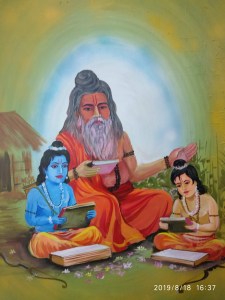
स तु मेधाविनौ दृष्ट्वा वेदेषु परिनिष्ठितौ।
वेदोपबृंहणार्थाय तावग्राहयत प्रभु:।।1.4.6।।
The sage who was a stickler of religious vows composed the entire epic rAmAyaNam where in he wrote in great detail the wonderfully strong character of sItA and the vanquishing of poulastya, i.e. the demon rAvaNa.
काव्यं रामायणं कृत्स्नं सीतायाश्चरितं महत्।
पौलस्त्यवधमित्येव चकार चरितव्रत:।।1.4.7।।
This is again an important verse that underscores the key driver of the story, sItA, who endures quite some trials so that rAma is successful in his mission.
The composition is enthralling and sweet in recital as well as song, confirming to the threefold paces, i.e. slow, normal and fast, comprising of the seven notes and amenable to be played on the stringed instruments. While singing melodiously, the epic evokes the feelings of warmth, compassion, humour, valour, fear, as well as violence!
रसैश्शृङ्गारकारुण्यहास्यवीरभयानकै:।
रौद्रादिभिश्च संयुक्तं काव्यमेतदगायताम्।।1.4.9।।
[These are known as the various rasAs, meaning the essence of the feelings and a masterful composition needs adequate representation of each of these.]
The princely and enchanting brothers kuSa and lava, not only appear charming like the gandharvas, they also sing like gandharvas having complete expertise of music and exploring the notes, endowed with an attractive voice, well-behaved and verily look like the reflected images of rAma himself!
The disciplined and dharmic princes impeccably and flawlessly committed the entire epic to memory just as taught by maharshi and melodiously rendered the composition in the meetings of saint, learned brahmins and sages. As they melodiously and heartily rendered the composition, on a certain occasion, the sages who were in the audience were astonished, completely touched and moved to tears by the music, content and presentation of the composition and hailed them, saying, “excellent, excellent”! The dharmic and loving sages were so overcome that they heaped praise on their rendition as well as the composition of the verses pregnant with poetic beauty and factual content. The brothers blessed with sweet voices as well as a rich knowledge of the swaras and music, singing in perfect unison, excelled in the presentation even more as the sagely audience were so completely overcome by it. The rshis who were present generously gifted them with garments, pitchers, and more. This wonderful epic poem rAmayaNam, composed by the foremost among poets, vAlmIki, set in perfect chronological sequence and rendered by the princely brothers, received thunderous applause wherever it was rendered, be it in meetings or on principal roads, conferred ultimate joy and bliss on the admiring listeners, who blessed them with long lives and prosperity.
While kuSa and lava were so immersed in one such presentation on a highway, rAma who was passing by on the chariot happened to see them. He respectfully invited the twins to his royal palace and extended due hospitality to them.
The tormentor of enemies, lord rAma then ascended on to his golden throne, surrounded by his brothers and ministers. He turned to them and said, ‘May you all listen to this wonderful presentation filled with lovely words and sense by these illustrious brothers and let them commence.’ They began the recital with a pleasing voice, having stringed their instruments and enthralled the entire audience in the royal court of rAma. The audience went into raptures feeling the joy in their mind, heart and whole being. rAma himself exclaimed, even though kuSa and lava are ascetics, they have distinct features of royalty. Their clear, devout and experiential rendition of the great epic, with complete mastery of both words and music, is conducive to even my well-being. Let us listen to this with one-pointed concentration.
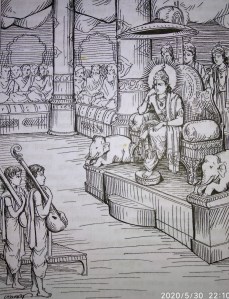
Thus encouraged by the kind words of the emperor rAma, the twin brothers continued their recital in a classical manner and rAma himself concentrated on the rendition with his whole heart.
Here we conclude the 4th sarga of the bAla kAnDam of SrImath vAlmiKi rAmAyaNam and humbly offer it at the lotus feet of SrIrAma. Hari: Om!
jAi SrIrAma.
[This sarga is thrilling at several levels. First, it establishes the veracity of vAlmIki rAmAyaNam with the stamp of approval of SrIrAma himself. Second, it caused joy to whoever listened to it. Third, it is both meaningful and musical, thus serving the heart as well as the soul. Last, but not the least, rAma himself claimed that it gave peace to him and exhorted everyone to listen with concentration. I think that is well an exhortation to us all.
Until here, vAlmIki develops the context of how he came about the composition of the epic. The strong desire to write about the sacred life of a wonderful being, meeting nArada who tells him the story of rAma briefly, how vAlmIki accumulates the wherewithal to write the epic with his deep contemplation and the blessings of lord brahmA. Then he lays out the structure of the epic and teaches the same to kuSa and lava. The twins master the epic and go around in ayOdhya singing it with joy and devotion and thrill the hearts of listeners. And finally the fragrance of the epic reaches rAma himself who puts his ultimate stamp of approval on this epic to make it the life giving flow of his story for generations to come, nay, for eternity, as lord brahmA himself pronounced, rAmAyaNa shall be recited on the earth as long as there are hills and rivers on the earth. That is in fact akin to saying man needs rAmAyaNam as much as he needs rivers and hills. So we must protect our rivers, hills, and as importantly, rAmAyaNam! The story now unfolds in daSaratha’s ayOdhya. Let us all pay attention and listen, because the maryAdA purushOttam prabhu SrIrAm himself is listening to his story in his royal darbar!
jAi SrIrAma.
Previous: bAla kANDam, sarga 3
Next: bAla kANDam, sarga 5
 rAmabhaktisAmrAjyam